On March 25, 2026, a jury found Meta and YouTube negligent. If you have been putting off building your owned media strategy 2026, this verdict just removed your last excuse to wait.
The verdict is not just a legal story. It is the clearest external signal yet that the era of “build your audience on someone else’s platform” is entering a new and significantly riskier phase. Every business that relies on social platforms for traffic, leads, or revenue should be rethinking its distribution strategy right now.
What the March 25 Verdict Actually Found
The case alleged that Meta and YouTube knowingly deployed algorithmic recommendation systems that caused measurable harm to users, despite internal evidence their own teams had flagged the risks.
The jury’s finding of negligence carries specific legal weight. By finding for plaintiffs, the jury rejected the platforms’ core defense — the Section 230 shield — establishing that juries are willing to hold platforms liable for the design of their algorithmic systems, separate from the content itself.
The platforms will appeal. But the direction of travel is now clearer than it has been in a decade.
Why This Changes Everything
Platform executives have operated for years with a comfortable assumption: whatever harms their recommendation algorithms cause, the legal exposure is manageable. Section 230 has been an almost impenetrable shield. That assumption just took a meaningful hit.
Here is what changes in the aftermath of a negligence verdict:
Insurance and risk modeling. Platforms will start facing higher liability insurance costs and investor pressure to de-risk their algorithmic systems. That means changes to how recommendations work, which means changes to how your content gets distributed.
Regulatory momentum. A successful jury verdict gives legislators and regulators a legal hook they did not have before. Expect more aggressive legislative proposals that could further constrain platform behavior.
Advertiser behavior. Major advertisers watch legal risk closely. Platforms under active legal scrutiny become less attractive for brand advertising, which affects platform revenue, which affects how aggressively they invest in organic reach for creators and publishers.
Content policy pressure. To reduce future liability exposure, platforms will tighten content policies further. More automated enforcement. More false positives. More accounts and content de-platformed without clear recourse.
Every one of these downstream effects makes the platforms less reliable as distribution channels. And that is the core issue for anyone building a business on top of them.
Algorithmic Platform Risk Is Now Legal Liability
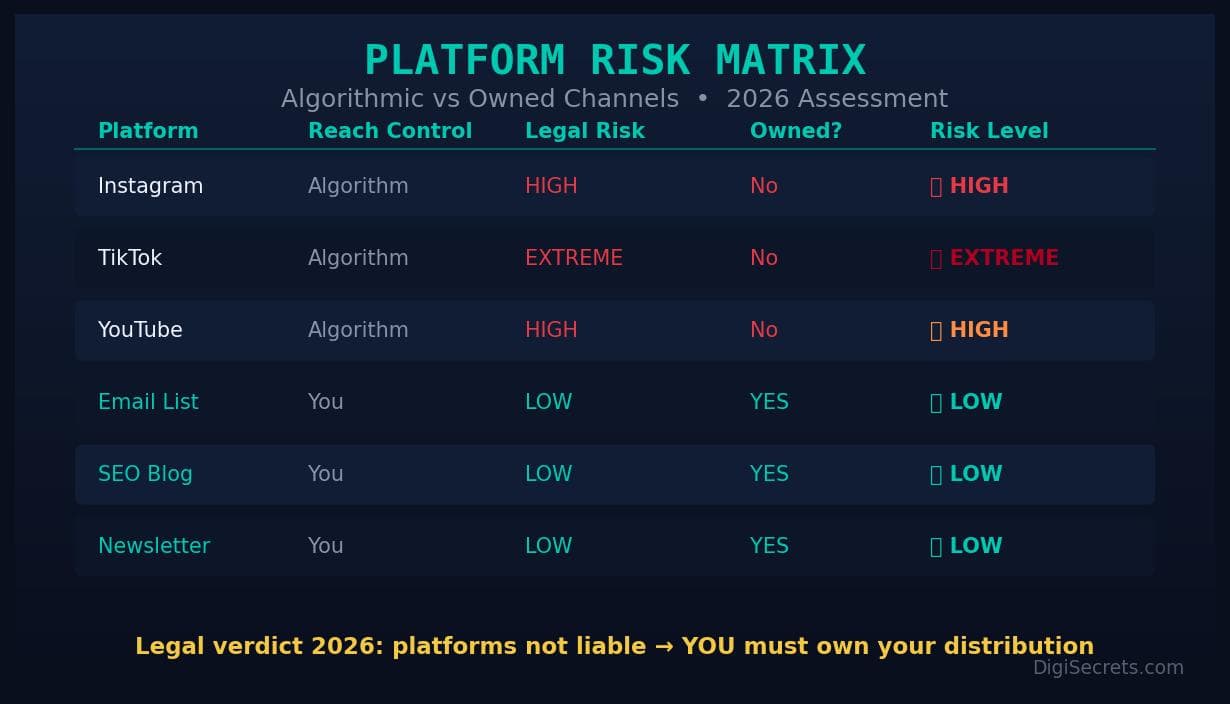
Your Meta page can be demonetized without notice. Your YouTube channel can be suspended by an automated review. Your Instagram reach can be throttled by an algorithm update. Your TikTok can disappear overnight if the regulatory environment shifts.
None of these happen because you did anything wrong. They happen because the platform’s incentives diverged from yours, and you have no contract protecting your reach, revenue, or audience relationship.
The March 25 verdict adds a new dimension to this risk. If platforms are found negligent for their algorithmic decisions, they will respond by making those algorithms more conservative and restrictive. The algorithm that once rewarded reach will prioritize liability reduction. Your content gets caught in that tradeoff.
Building on someone else’s platform has always been risky. It is now demonstrably more risky than it was a week ago.
Your Playbook: Owned Media Strategy 2026

The owned media strategy 2026 that I am building and recommending to anyone who asks is not complicated. It is three channels, built in order of impact.
Pillar 1: Email
Email is the only distribution channel where you own the relationship completely. Your list cannot be algorithmically throttled, de-platformed, or deprioritized. When an algorithm update wipes out your organic traffic, email still works.
The target: 10,000 engaged subscribers is worth more than 100,000 social followers. Email open rates for healthy lists sit at 20–30%. Organic social reach for comparable audiences often sits below 5%.
Pillar 2: SEO and Organic Search
Search is not platform-dependent in the way social is. Google’s algorithm changes, but in ways more predictable and more tied to content quality than any social recommendation engine. A piece of content that ranks in organic search generates traffic continuously — without paying for distribution or staying on the algorithmic good side of a platform facing a negligence verdict.
The owned media strategy 2026 shift I am making is simple: every hour I previously spent on platform-native content now goes toward content built for search. Longer form. More depth. More original data and perspective. Content that compounds over time rather than expiring in 48 hours.
For a full breakdown of how to build an SEO content system that generates durable organic traffic, DigiSecrets has detailed guides on AI-powered SEO strategy for independent publishers.
Pillar 3: Your Own Website and Direct Channels
Your website is your home base — the only place on the internet where the rules are completely yours. In a world where platform policies are driven by legal liability management rather than creator success, your own domain is your most defensible asset.
Direct traffic, branded search, and returning visitors are insulated from platform decisions in a way that social metrics fundamentally are not.
The Shift from Social to Owned: Data and Numbers
The data on platform reach decline has been building for years. Facebook organic reach dropped from ~16% in 2012 to under 2% today. YouTube’s algorithm changes in 2023–2024 produced significant reach volatility for mid-tier creators. Instagram’s Reels-first shift has penalized link-sharing and text-heavy content.
Email benchmarks, by contrast, have held steady — 20–35% open rates, with click-through rates outperforming social by 5–10x. SEO content from 2026 can still generate traffic in 2028 without additional investment. Platform content expires in days.
The verdict does not create this math. It just makes the urgency higher than it has ever been.
Conclusion
The March 25 verdict finding Meta and YouTube negligent is a legal inflection point. It changes the risk calculus for platforms, which changes platform behavior, which changes what happens to your content and your reach on those platforms.
The owned media strategy 2026 response is not complicated: build your email list, invest in SEO and organic search, and make your own website the center of gravity for your audience relationship.
The platforms will always offer reach. They will offer it on their terms, with their rules, at their pleasure, and subject to their legal risk management decisions. You have no contract. You have no protection. You have no recourse when the algorithm changes or the policy tightens.
Your email list is yours. Your search rankings are yours. Your website is yours. No jury verdict, no algorithm update, and no platform policy change can take them.
The time to build was five years ago. The second best time is now.
Keywords: owned media strategy 2026, Meta YouTube verdict, email marketing, SEO strategy, platform risk
Leave a Reply