As a solopreneur, I’ve been there. Spending hours writing content, watching the traffic dashboard climb, getting a dopamine hit from page views — and then wondering why none of it was turning into money.
The Google Analytics screenshot looks great. The ranking moved. The impressions are up. And yet the revenue number at the end of the month doesn’t budge.
That’s not a content problem. That’s a metrics problem.
Most content creators are measuring the wrong things. Not because they’re lazy or uninformed — but because the metrics that are easiest to see are the ones that feel the most real. Traffic is visible. Rankings are trackable. Bounce rate makes you anxious in a productive-feeling way.
But none of those metrics predict revenue. There’s one that does. And once you know it, you’ll never go back to obsessing over page views again.
The Traffic Vanity Trap That’s Draining Your Energy
Vanity metrics are measurements that feel important and look impressive but have no reliable connection to income.
Page views are the worst offender. You can have 50,000 monthly visitors and earn nothing. You can have 3,000 monthly visitors and run a six-figure business. The number itself is meaningless without context — and the context that matters is whether those visitors are taking any action that moves toward a transaction.
Rankings are only slightly better. Position 3 for a high-volume keyword is worth something, but only if the people clicking that result are the right people with the right intent. Ranking for informational queries that attract students, researchers, or tire-kickers gives you traffic and zero revenue lift.
Email open rates are the vanity metric hiding inside what feels like a real metric. Yes, email is a high-intent channel. Yes, open rate tells you something. But someone who opens your email every week and never buys anything is not a revenue signal — they’re an engagement signal. Different thing.
The reason solopreneurs get caught in this trap is systematic. Every tool you use to run your content business defaults to showing you these numbers. Your SEO plugin reports rankings. Google Analytics opens on the traffic overview. Mailchimp leads with open rate. The dashboard is built around what’s easy to measure, not what matters.
The One Content Metric That Predicts Revenue for Solopreneurs
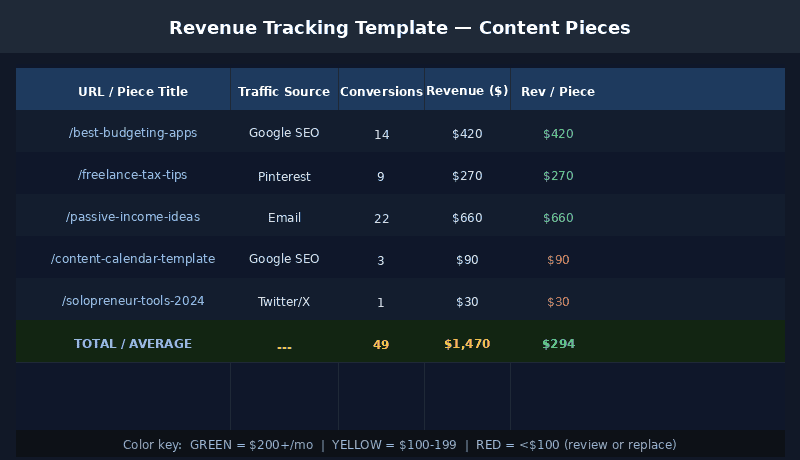
The metric is content conversion rate — specifically, the percentage of visitors to a given piece of content who take a revenue-connected action.
That action can be:
- Joining your email list (if your list has a functioning sales funnel behind it)
- Clicking an affiliate link
- Visiting a product or service page
- Booking a call or filling out a contact form
- Making a direct purchase
The key phrase is “revenue-connected.” Not just any action. An action that sits on the path to money.
Here’s why this metric predicts revenue when everything else doesn’t: it tells you which content is actually working as a business asset versus which content is just generating noise. A piece with 200 monthly visitors and a 4% conversion rate is worth more to your business than a piece with 8,000 monthly visitors and a 0.1% conversion rate. The math is simple. The implications are significant.
Content conversion rate forces you to think about your content differently. Every article becomes a question: does this piece move someone toward a transaction? If the answer is no — if the content is purely informational with no natural path to revenue — you’ve identified either a gap in your funnel or a topic you shouldn’t prioritize.
Why Your Current Metrics Are Lying to You
The problem with traffic, rankings, and email opens isn’t that they’re useless. It’s that they’re lagging or disconnected.
Traffic tells you what happened after your SEO worked. Rankings tell you where Google filed your content. Open rates tell you your subject lines are functional. None of these metrics tell you whether your content is building a business or just an audience.
And there’s a subtler problem: optimizing for vanity metrics actively moves you away from revenue. If you’re chasing page views, you write broad content that attracts large, low-intent audiences. If you’re chasing rankings, you optimize for keywords that may have no commercial value. If you’re chasing open rates, you write email subject lines that tease curiosity without delivering substance.
The feedback loop runs backwards. You feel productive. The numbers go up. The revenue doesn’t follow.
Content conversion rate breaks this loop because it’s directly tethered to outcome. You can’t accidentally inflate it by chasing unrelated signals. The only way to improve it is to either drive higher-intent traffic to your best converting content, or make your content better at moving people toward a revenue-connected action.
If you want to understand how AI is reshaping this entire process, check out how AI agents are changing how solopreneurs work — the short version is that automation now makes it practical to track and act on conversion data that used to require a dedicated analyst.
The Solopreneur Advantage: You Can Move Faster Than Anyone
Here’s something enterprise content teams can’t do: audit every piece of content you’ve ever published and rebuild your strategy around a single, clarifying metric in a weekend.
Large teams have legacy content, stakeholder politics, editorial calendars booked six months out, and multiple people who need to sign off on anything that changes. You have none of those constraints.
This is the solopreneur advantage. You can look at your last 12 months of content, identify which five articles drove actual revenue-connected actions, and decide right now to write more of that — and less of everything else.
It takes one afternoon in Google Analytics with goals or events set up properly, one afternoon in your email platform connecting campaigns back to content sources, and a simple spreadsheet. That’s it. You have the information that most teams spend quarters trying to synthesize.
The Optimization Loop That Changes Everything
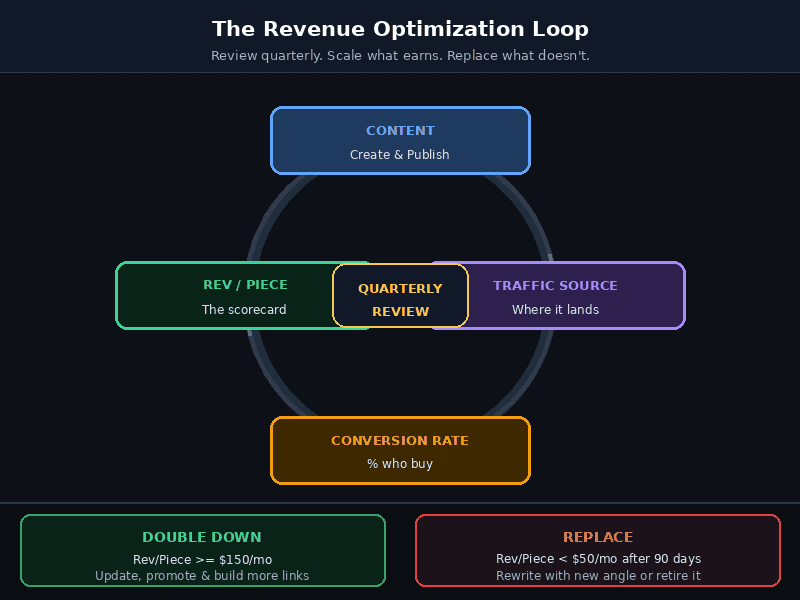
Once you’re tracking content conversion rate, a feedback loop opens that compounds over time.
You identify your highest-converting content. You study what makes it work — the topic, the format, the CTA placement, the traffic source, the search intent behind it. You replicate those elements in new content. You revisit older content that gets traffic but doesn’t convert, and you add better CTAs, tighter funnel paths, or more targeted internal linking.
Every piece you publish now has a job description, not just a keyword target. Every optimization decision is grounded in a number that actually connects to revenue.
This is how solopreneurs with small audiences outperform creators with large ones. Audience size is a vanity metric. Conversion rate is a business metric.
For a broader view of how AI tools are changing what’s possible in content strategy, The influence of AI in blogging and content creation is worth your time — especially if you’re thinking about how to automate the tracking and iteration side of this loop.
Stop measuring what’s easy to see. Start measuring what predicts revenue. Everything else is noise.
Leave a Reply